
The Deepest Human Need

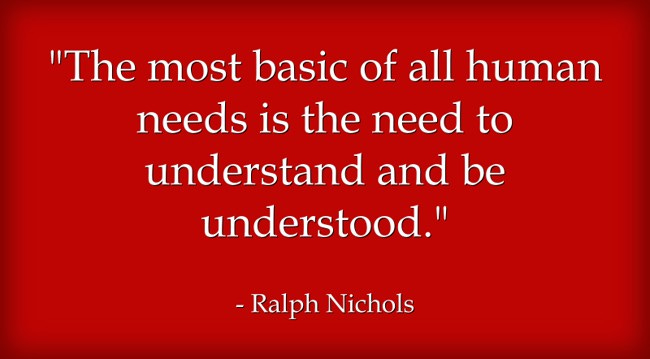
One of the deepest human needs is to feel understood.
Most people immediately think of love, belonging, connection, and acceptance when they think about healthy relationships. But underneath all of those things is something even more fundamental. We want someone to understand what it feels like to be us. Not the polished, the successful, or the version that performs well.
The real version.
Think about the people you feel closest to. Chances are it is not because they always gave the best advice. It is not because they fixed your problems or had all the answers. It is because they listened. They understood. They made you feel seen.
That feeling is far more powerful than most people realize.
Many people assume loneliness comes from being alone. Sometimes it does. But the deepest loneliness is not being alone. It is being surrounded by people who know your role but do not know you. People who know you as a father, husband, wife, employee, friend, provider, leader, or caretaker, but have very little understanding of your inner world. They know what you do. They do not know what it is like to be you.
There is a particular kind of loneliness that comes from realizing the people around you know your responsibilities better than they know your inner world. You can be surrounded by people and still feel completely alone when you do not feel understood.
Children experience this in an even deeper way.
When adults repeatedly misunderstand a child, the child rarely concludes that the adults are mistaken. Children naturally look to their parents for help understanding themselves. If a parent constantly dismisses, minimizes, ignores, or misinterprets what a child is feeling, the child usually reaches a different conclusion.
Something must be wrong with me. This is one of the hidden wounds many people carry into adulthood.
A child says, “I’m scared,” and hears, “You’re fine.”
A child says, “I’m upset,” and hears, “Stop overreacting.”
A child says, “That hurt my feelings,” and hears, “You’re too sensitive.”
The parent may have good intentions, but the message the child receives is that their feelings do not make sense.
After enough experiences like this, many children stop trusting their own emotions. They stop trusting their own perceptions. They learn to look outside themselves for answers rather than understand themselves from within.
The deepest wound is not that they feel misunderstood. The deepest wound is that they begin to misunderstand themselves. The child concludes something is wrong with them, that parts of themselves are unacceptable, and their internal experience cannot be trusted.
Eventually they stop asking, “What am I feeling?” and start asking, “What am I supposed to feel?”
Most people think the pain of being misunderstood is that nobody gets you. The deeper pain is what happens next.
When a child repeatedly hears that their feelings are wrong, irrational, dramatic, selfish, or excessive, they begin doubting themselves. They stop listening to their own emotions. They stop trusting their own experience. Over time, they become strangers to themselves.
Many adults are still living with the consequences of that disconnect. They know how to perform, how to please, how to achieve, and how to be who everyone else needs them to be, but they have no idea who they are when nobody is looking.
This is why emotional validation is so important.
Validation does not mean agreement. It means communicating that someone’s experience makes sense from where they are standing.
Ironically, many adults spend their lives chasing love when what they are really searching for is understanding. Many learned very early that being themselves was risky. Being emotional, sensitive, angry, afraid, and honest was risky.
So they adapted. They become successful. They become helpful. They become impressive. They learn how to earn approval and admiration. They learn to play roles that others appreciate. Yet many still feel lonely. Because being accepted for who you pretend to be will never feel as good as being understood for who you actually are.
People can love the image you present to the world. They can love the role you play. They can love the version of you that makes sense to them.
But there is something profoundly healing about having another human being see the real you and say, “I understand.” Most people want to be understood. Far fewer people know how to understand.
Understanding requires curiosity. It requires slowing down. It requires setting aside the need to fix, correct, advise, judge, or win. It requires being willing to enter someone else’s world without forcing them into your own.
Most people listen to respond. Very few listen to understand. Listening is one of the rarest forms of generosity because it requires setting yourself aside long enough to fully enter someone else’s world.
Perhaps that is why being understood feels so powerful. For a moment, we stop explaining ourselves. For a moment, we stop defending ourselves. For a moment, we stop performing. Someone sees what is happening inside us and instead of correcting it, fixing it, judging it, or arguing with it, they understand.
In that moment, we receive something many of us have been searching for since childhood. Not just permission to be ourselves. Something even deeper. The feeling that we make sense. That our emotions make sense. That our experiences make sense. That we are not broken, defective, dramatic, weak, or too much.
That we make sense.
Maybe that is one of the greatest gifts we can give our children, our partners, our friends, and ourselves. Not constant advice, not constant correction, and not constant solutions. Just the experience of being fully seen and understood.